
Recent Posts



August 21, 2026
Standing in front of a row of treadmills, or scrolling through a dozen browser tabs trying to compare specs, is enough to make anyone give up and just buy whichever one looks the nicest. The problem is that treadmills are not one-size-fits-all. What works for a beginner who wants a gentle daily walk is very different from what a regular runner needs to stay injury-free.
Getting this decision right matters more than it seems. A treadmill you actually enjoy using is one you will keep coming back to, and consistency is what turns cardio into a habit that supports your heart, your energy levels, and your long-term health. A treadmill that is too weak, too cramped, or too uncomfortable ends up as an expensive clothes rack.
This guide breaks down exactly what to look for, in plain terms, so you can choose with confidence no matter your budget or fitness level.
Start with how you will actually use it
Before looking at any spec sheet, get honest about your workout style. Are you planning to walk most days, mix in some light jogging, or train for running? This single question shapes almost every other decision on this list.
A dedicated walker does not need the same top speed or motor strength as someone training for a 10K. Buying more machine than you need just adds cost, while buying less than you need means you will outgrow it within months.
Motor power: The part everyone skips and shouldn’t
Motor power is usually listed in horsepower, often written as HP or CHP (continuous horsepower). This number tells you how well the treadmill can handle sustained use without straining.
For walking and light jogging, a motor in the 1.5 to 2.0 CHP range is generally enough to keep the belt moving smoothly. If you plan to run regularly or if more than one person in the household will use the machine, a stronger motor in the 2.5 to 3.0 CHP range will hold up better over time and run quieter under load.
A weak motor working overtime is one of the most common reasons home treadmills break down early, so this is not a spec worth cutting corners on.
Incline: Manual or automatic, and why it matters
Incline changes how hard your body works without you needing to increase speed. Walking on even a gentle incline burns more calories and engages your glutes and hamstrings more than walking flat.
Entry-level treadmills usually come with manual incline, where you physically adjust the level before starting. Mid-range and higher-end machines offer automatic incline, adjustable at the touch of a button, sometimes across fifteen to twenty levels. If incline training is something you want to build into your routine, automatic adjustment makes it far easier to actually use consistently.
Running surface, cushioning, and comfort
The size of the running deck matters more than people expect, especially for taller users or anyone planning to jog or run rather than just walk. A cramped deck can feel unsafe at higher speeds.
Cushioning is just as important. Good shock absorption reduces the impact on your knees and ankles with every stride, which makes a real difference if you are logging regular sessions. If joint discomfort is a concern for you, it is worth speaking with a doctor or physiotherapist about what impact level is appropriate before starting any new routine.
Space and foldability: The Sri Lankan home gym reality
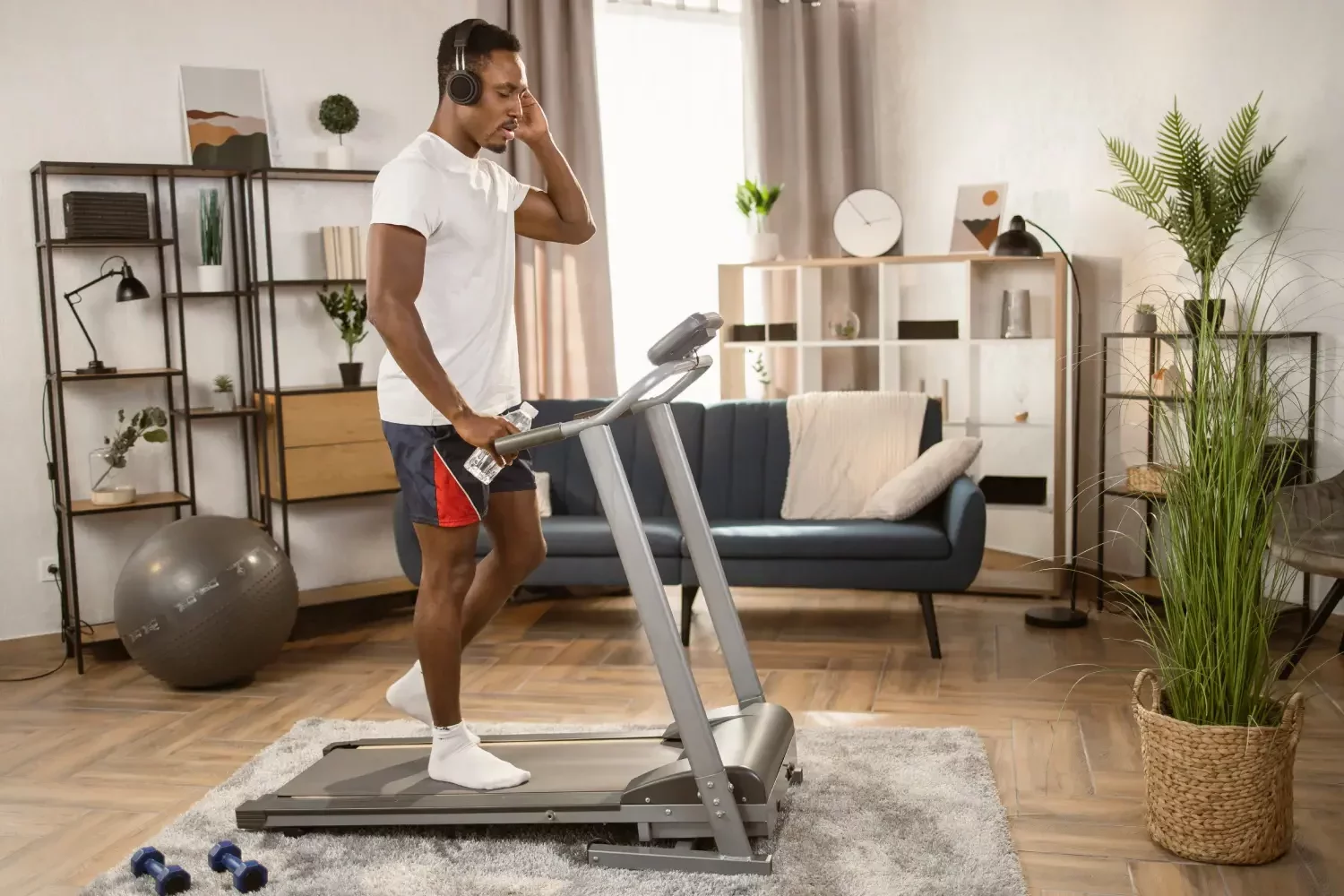
Most home gyms here are not spare rooms with wall-to-wall equipment. They are a corner of the living room, a section of the balcony, or a spot that needs to be cleared for other use during the day.
This is where foldability becomes a genuinely practical feature rather than a nice extra. Look at how easily the deck folds up, how much floor space it needs when folded, and whether it has wheels for moving it out of the way. A treadmill that is a hassle to store is a treadmill that quietly stops getting used.
User weight capacity and warranty
Every treadmill has a maximum user weight rating, and running a machine near or above that limit puts extra strain on the motor and frame. Check this number honestly against who in the household will be using it.
Warranty length is also a useful signal of how confident the manufacturer is in the build, particularly for the motor, which is the most expensive part to repair or replace. Longer motor warranties generally point to a machine built for more serious, sustained use.
Extra features worth having (and ones you can skip)
Preset workout programs, Bluetooth speakers, and built-in heart rate sensors are common on mid-range and higher-end treadmills. Heart rate monitoring is genuinely useful if you want to train within a specific intensity zone. Preset programs are a nice way to add variety without having to plan every session yourself.
Bluetooth speakers and phone holders are more about convenience than performance, so treat these as tiebreakers between two similar machines rather than must-haves.
A simple step-by-step way to decide
If you are still not sure where to start, work through it in this order.
- First, decide your primary use: walking, jogging, or running, and be realistic rather than aspirational.
- Second, set a budget range and treat motor power and warranty as the two specs you do not compromise on within that range.
- Third, measure the space where the treadmill will actually live, including room to fold it away, and rule out anything that will not comfortably fit.
- Fourth, check the user weight capacity against everyone who might use it, not just yourself.
- Fifth, treat incline, preset programs, and connectivity features as the deciding factor between your final two or three options.
Finding the right fit at every budget
Once you know what to look for, matching it to an actual machine gets a lot easier. Here is how a few different treadmill types tend to line up with different needs.
If you are just starting and your main goal is building a consistent walking habit, an entry-level treadmill with a manual incline and a moderate speed range is usually plenty. It keeps the investment low while you figure out what you actually want from your routine, something the Quantum Home Walker T101 is built for.
If you are ready to mix in some jogging and want a bit more variety in your sessions, stepping up to a treadmill with a wider speed range and built-in workout programs, like the Quantum Active Jogger T120, gives you more room to grow without a huge jump in price.
For those who want automatic incline, heart rate tracking, and a stronger motor to support regular training, a mid-range option such as the Quantum Prime T218 hits a good balance between features and cost.
If running is a regular part of your routine, or more than one person will be using the treadmill often, a machine with a higher top speed, more incline levels, and a higher weight capacity, like the Quantum Power Track T220, is built to handle that kind of frequent, higher-intensity use.
And for households that want a larger running surface, a stronger motor, and the kind of build quality meant for daily, long-term use across different fitness levels, something like the SOLE F63 treadmill is designed to go the distance.
You can browse the full range and compare specs side by side at Quantum Fitness, which makes it easier to see how each model lines up against what you actually need.
The bottom line
Choosing a treadmill does not need to be complicated once you know what actually matters: how you will use it, motor strength, incline, comfort, space, and weight capacity. Get those right and the rest is just personal preference.
The best treadmill is not the most expensive one or the one with the longest feature list. It is the one that fits your space, your budget, and your routine well enough that you actually use it, week after week.
Ready to find the right fit for your home gym? Explore the full treadmill range at quantum.lk and find the machine that matches where you are in your fitness journey right now.